- 1234, occupation no more, 5678, Tibet is-an apartheid state!
- New Zealand (or whether you are) please choose a side, human rights or apartheid!
- From Tibet, to Palestine, occupation is a crime!
- Hey, hey, ho, ho! Occupation has got to go!
- One solution, revolution!
- The people, united, will never be defeated!
- Tibetans are under attack. Stand up, fight back!
- (front calls) FREE TIBET, (back calls) FREE TI-BET!
- When I say peace, you say now! Peace! Now! Peace! Now!
- Free Tibet, not free trade!
Showing posts with label Non-violent Action. Show all posts
Showing posts with label Non-violent Action. Show all posts
Friday, 10 August 2012
Suggested chants / slogans for a Free Tibet protest:
Suggested chants / slogans for a Free Tibet protest:

Free Tibet Protest in Dunedin, New Zealand
100 people participated in a protest
organized by Students for a Free Tibet (SFT), the Organisation for Global
Nonviolent Action (OGNA) and the Coalition for Tibet Aotearoa on Friday the 4th of
August in the city centre of Dunedin, New Zealand.
The protest was called in light of the
current situation in Tibet, which is at its worst since the Chinese invasion in
the 1950's.
“In the last year alone there have been
47 self-immolations in Tibet in protest to the Chinese government's rule and
oppression”, says Joe Llewellyn, co-leader of SFT and OGNA.
Starting from the Peace Pole in front of
the Otago Museum, the crowd marched, with a banner saying "Tibet is burning - end the oppression of: Tibetans, Uyghers, Mongolians and Chinese", to the front of the Meridian Shopping
Centre, blocking off George Street traffic to perform a ‘die-in’ – a symbolic
lying down to symbolize the lives lost in the conflict that is ongoing in
Tibet. The group then progressed to the Octagon lawns where speeches
were made, and the printed faces of the 51 self-immolators were lined up to
emphasize the tragedy of the situation.
The march and die-in were well received
by the public, the die-in deliberately held only for a few minutes to minimize
disturbances to traffic. People from the sidewalks began joining the
march as the crowd progressed and many cars showed their support by
honking.
“Since the Beijing Olympics the
situation has become increasingly worse, with an increased military presence
and regular media blackouts”, says Joe Llewellyn.
The Chinese Government has a track record
of silencing political dissidents, Liu Xiaobo, Ai Wei Wei and Chen Guangcheng
are recent examples, though many more remain unreported. Mr. Llewellyn says
“There are now hundreds, if not thousands, of political prisoners- reports
indicate the latest self-immolations have lead to 600 more Tibetans being
incarcerated”.
Speaking about a recent report from the
Washington-based Human Rights Watchdog, Freedom House, he said: “Freedom House
have just upgraded Tibet in their 'Worst of Worst list' together with countries
such as Somalia, Saudi Arabia and North Korea. It's a list of the top nine
countries in terms of human rights violations”.
He says, “We are protesting to raise
this under-reported issue. It also gives people a chance to have their say on
it”.
“We are planning future action including
a nation-wide petition and protests before the Dalai Lama's visit to New
Zealand next year”.
Mr. Llewellyn says “The Free Trade Agreement New Zealand has with China should not be to the detriment of Chinese minorities”.


Saturday, 9 June 2012
Reviews: Flim - Budrus
Called "a timely testimony to the power of peaceful resistance" (Tom Dawson of Total Film) Budrus documents the strictly non-violent reaction of a West Bank townn to Israel’s construction of the ‘Separation Barrier’ in the early 2000’s. Budrus, a town of 1,500 Palestinians stood to lose 300 acres of land and 3000 olive trees if the Israeli Government’s plans went ahead – trees and land critical to economic survival, as well as being a sacred part of an intergenerational history.

The film places you in the world of Ayed Morrar, a Palestinian whose previous work for the political group Fatah had led to five detentions in Israeli prisons – a man not predisposed to non-violent action. His strategic decision that the ‘Wall’ would be best opposed by non-violent tactics makes the film an all the more interesting watch.
The successes that unfold as non-violent strategies are put in place and courageously adhered to paint a colourful picture of what peaceful resistance can achieve: the unification of previously feuding political groups; the involvement of women in the heart of a struggle; the coming together of civilians from warring countries as they come to separate the people from actions done in their name, but without their consent.
Combined with interviews with the Israeli Border Police captain and military police spokesperson, Budrus allows for a certain balance in views to be obtained. A must-see film that shows a piece of history in the Occupied Palestinian Territories that many Palestinian and Israeli citizens still now little about.
Non-Violent Warriors: Mahatma Gandhi (1869-1948)

It is hard to properly study Gandhi’s moral and political concepts without studying his personality. Einstein said of him that generations to come will “scarcely believe that such a one as this, ever in flesh and blood, walked upon this earth”. More books and essays have been written about Gandhi than any other figure in world history apart from the founders of great religions. He has been celebrated as perhaps the greatest man to live in the 20th century and has been compared to a wider range of historical personages than anyone else, from the likes of the Dalai Lama, Krsna, Rama, Buddha and St Joan, to Cromwell, Jefferson, Mazzini, Lincoln, and Lenin, and yet again to Thoreau, Marx, Rousseau and Tolstoy – comparisons that can be more confusing than helpful but none the less show his level of influence and how many people admire him.
Gandhi combined many roles in his life that show why these comparisons were made. He was the leader of a large successful human rights campaign in South Africa in the early 1900’s; he was a skilled lawyer; the founder of many ashrams and communes; a voice against oppression as he championed many causes such as woman’s rights, animal rights and rejected the caste and class systems; and the revolutionary leader of a mass nonviolent movement that played a very large part in removing the British from India.
Unfortunately his personality, radiant goodness and kindness, has had such an intense impact that it has diverted attention from his claims to be a political thinker. In India he is viewed more as a saint or a prophet than a revolutionary and is called “the father of the nation” – this is compensation by a large portion of the intelligentsia for its failure to study his writings and to put serious consideration into his moral and political thoughts. Moral and political thought that showed the world that revolution is possible without ever taking up arms.
Gandhi’s life
Mohandas Karamchand Gandhi was born in 1869 in Porbander in the state of Gujarat, India.
He studied Law in London and was called to the bar in 1891. He then enrolled in the high court of London but later that year returned to India where he accepted a job at an Indian law firm in Durban, South Africa. While in South Africa, Gandhi became appalled with the treatment of Indian immigrants who were without political rights. He decided to fight the South African government and launched a non-violent direct action campaign.
After seven years of non-violent action and multiple periods in prison, Gandhi and his followers forced the South African government to concede to many of Gandhi’s demands. He returned to India shortly afterwards.
In the 1920’s Gandhi attracted millions of followers as he began campaigning for Indian independence from Britain by organising strikes, boycotts of British goods and institutions, as well as protests. He knew that it is impossible to rule without cooperation and showed that much can be done to achieve this without acting with aggression. In 1930 he wrote “Much can be done... Liquor and foreign cloth shops can be picketed. We can refuse to pay taxes if we have the requisite strength. The Lawyers can give up practice. The public can boycott the Courts by refraining from litigation. Government servants can resign their posts...” Throughout his life he put many of these tactics and more into practice to force the British out of India.
 |
| Gandhi and followers on the famous “Salt March in 1930 |
As the peaceful non-cooperation movement grew, Gandhi was sentenced to six years in prison - just going to show how effective his actions were and how much of a threat his movement had become to British rule. He viewed this as a success and it did not deter him as the nonviolent resistance movement continued to grow.
On the 6th of April, 1930, a 61 year old Gandhi, now addressed by many as Mahatma (great soul), embarked on his most famous act of nonviolent action. He arrived at small village on the Indian coast and gathered salt. Soon hundreds of thousands of people were doing this – breaking the British salt laws. This may seem like a relatively insignificant law to break but salt was something that was needed by all members of Indian society, rich and poor. This act showed a defiance of the British monopoly on a vital resource, that neither they nor anybody else had a right to control. From this simple act, the civil disobedience movement grew and Gandhi, along with thousands of others, was again arrested. This only succeeded yet again in increasing Gandhi’s support and the numbers of people engaging in non-violent action.
The British grew more and more worried at this response. They were well equipped at dealing with violent uprisings and crushing them but did not know how to respond to an active non-violent campaign. Throwing people in jail only succeed in gaining more support for Gandhi and in filling the prisons to the point that no further arrests could be made, the British were forced to release Gandhi, and sub-sequentially invited him to a round table conference in London to negotiate the possible terms of Indian independence.
The conference failed and it wasn’t until 1942 that Gandhi issued his last call for independence from Britain where he asked every Indian to lay down their life, if necessary, for the cause of freedom. The protests, strikes and boycotts started once again and in 1947 the British could no longer hold power and left India. Gandhi had succeeded in his aim to remove the imperial oppressors but unfortunately this did not lead to the world Gandhi was hoping to make as India split along religious lines into India and Pakistan. He was assassinated in 1948 by a Hindu nationalist fanatic.
 |
| A quote off of a Gandhi monument in South Africa |
Gandhi’s Politics: Ahimsa, Satyagraha and Civil Disobedience
Gandhi highly valued the principle of ahimsa, which literally means nonviolence. He believed that violence used against oppression was not only morally wrong but also a mistake. It could never really end injustice because it inflamed the prejudice and fear that fed oppression. He wrote in 1909 “The means may be likened to a seed and the end a tree; and there is just the same invioble [sic] connection between the means and the end as there is between the seed and the tree... we reap exactly what we sow”.
 |
| Gandhi teaching about Satyagraha in India |
Gandhi knew that the use of violence dehumanises those upon which violence is used, and can only create a system that is unequal and can never lead to peace – where the poles reverse and the oppressed become oppressors rather than creating equality.
Gandhi used methods of political action that were effective and nonviolent. He called this “passive resistance”- a term he later rejected as there was nothing passive about it. It worked like this:
1) Announce opposition to an unjust law (such as restrictions on free movement)
2) Break the Law (by crossing a border illegally)
3) Suffer the consequences (arrest, physical abuse, prison)
Gandhi believed that resister’s calm and dignified suffering would open the eyes of oppressors and weaken the hostility behind oppression. Rather than adversaries being bullied to give in they would be obliged to see what was right, and that would make them change their minds and actions. Gandhi called this satyagraha which translates to “truth” and “holding firmly”. Gandhi realised that for this to work it needed to do more than just appeal to oppressors. It needed to put pressure on them and force change.
Satyagraha was developed because terms such as Ahimsa, nonviolence, and the absence of violence, did not show the pro-active nature and the strength of his political action. Gandhi was a non-violent political activist, not a pacifist, and had contempt for any kind of non-active pacifism stating that he would rather see someone resist violently than not resist at all. He saw pacifism as cowardly, stating “Violence is any day preferable to impotence. There is hope for a violent man to become non-violent. There is no such hope for the impotent.”
 |
| Howard Zinn and Gandhi agree about the necessity of law breaking to make change |
In order to be forceful, satyagraha needed to threaten rule and control. Strikes stopped productions and vital services such as the communication networks the British relied on and well as power production and the transportation of food and water. Law breaking, or civil disobedience, despite the possible violent oppression from the British that could ensue, removed the British oppressors’ ability to bully and control.
Would Gandhi have been as successful if his was challenging a more brutal oppressor?
The argument has frequently been made that Gandhi’s tactics could only have worked against the British due to their “good nature”, “fairness” and “respect”. This argument fails to acknowledge that the British Empire was a ruthless fighting force that secured land and maintained control through its military. This is as true in India as it was throughout the rest of the British Empire.
No case shows this better than that of the Pathans who lived in and around the Khyber Pass – the gateway from India to Afghanistan. The Pathans were Muslim-tribesmen who where known as some of the most warlike people in the world (as were the British). The British sent thousands of troops into the Pathan hills to control the gateway to central Asia. They shelled the Pathans in the 19th century and bombed them from the air in the 20th. Thousand of Pathans were killed, flogged and beaten. After decades of this the Pathans made a decision that made them much more of a threat to the British – they joined Gandhi’s nonviolent movement. The “gentle” British did not believe that the Pathans were capable of this. They sealed off the area for two whole decades and brutalised the nonviolent resistors through mass executions, torture, imprisonment and hangings. Despite this, tens of thousands more Pathans swore vows of nonviolence and became a large part of the movement that removed the British from India.
 |
Khan Abdul Gaffar Khan leader of the Pathans with Mahatma Gandhi.
Khan was closely identified with Gandhi and he is known in India as the `Frontier Gandhi'.
|
Gandhi wanted to achieve a world of equality and peace. In 1931 a cartoon in “The Star” newspaper depicted him in a loin cloth besides Mussolini, Hitler, de Valera and Stalin, who were clad in black, brown, green and red shirts respectively. The caption, "And he isn't wearing any blooming shirt at all" was not only literally but figuratively true. For a man of nonviolence, who believed in the brotherhood of man, there was no superficial division of nations into good and bad, allies and adversaries. This did not, however, mean that Gandhi did not distinguish between the countries which inflicted and the countries which suffered violence. His own life had been one struggle against the forces of violence, and Satyagraha was designed at once to eschew violence and to fight injustice.
Gandhi’s life and struggles were only one out of many steps towards creating a world of peace and equality. He inspired many, such as Martin Luther King Jr. and His Holiness the Dalai Lama, who have used his methods since to make positive social change. We can do this and unite to overcome the injustices of the current world system as Gandhi has shown is possible. But to do so we must study the mistakes and the successes of revolutions throughout history; protest and campaign; organise and unite; and remove the elite and oppressors in our society- forcefully and non-violently in order to create a world of equality and freedom. History has show that oppressors will never voluntarily give up their power. Fortunately the likes of Gandhi have shown us that it is possible to remove them with the weapons of love and truth.
If you would like to do this, join the Organisation for Global Nonviolent Action (OGNA).
Hamas and Nonviolence?

The Palestinian political and terrorist group Hamas has been known to commit acts of violence since the First Intifada (Uprising against Israel), from 1987-93. This is also when Hamas began to gain political momentum in the Palestinian territories, with a goal to liberate Palestine and unite the territories into one Islamic state. Between 2001 to May 2008, Hamas launched more than 3,000 Qassam rockets and 2,500 mortar attacks into Israel. The attacks by Palestinians are often reported as the start of the altercations between the two nations, though this isn't the simple truth. Moreover, since December 2011, Hamas leader Khaled Meshal has anounced the group is committed to a tactical change towards non-violence, following the example of the Arab Spring. It is also pushing for elections and a long-needed unity between the two sides of Palestine. And by agreeing to do so is implicitly recognising Israel. Albeit Israel has ignored these claims without a change in its strategy towards Gaza.
 |
| Haniyeh—the Prime Minister of Gaza |
Since Israel was founded as an independent state in 1948, it has gone on a rampage to control land they believed theirs, but was already owned. The common line was to say it only had a few herders and goats, in truth the land had been farmed and occupied by Palestinians for millenia.
Despite Hamas being elected in Gaza in 2008, which legitimises the terrorist group and its actions, the Guardian reported the group would shift tactics towards nonviolent resistance “as part of a raprochement with the Palestinian Authority (PA)”. Though it was not a full repudiation of violence, the group asked its members to halt attacking Israel. Haniyeh, the Prime Minister of Gaza stated Hamas would agree to the PA's call for the '67 borders, this is an implicit acceptance of Israel, which it had hitherto denied.
Hamas is not the only terrorist group in Palestine, so its potential abdication of violence won't stop attacks on Israel, but it is the most influential.
The group later on said nonviolence would “draw world sympathy”, as the Arab Spring-style protests “have the power of a Tsunami”.
Subsequent Palestinian protests include the more-than-traditional shoe-throwing to a UN envoy with Ban Ki-moon in January, hunger strikes, and a called-for cyber-attack on the Tel Aviv Stock Exchange.
According to Israel's Ha'aretz newspaper coverage from the 18th of December to the beginning of March, Israel dismissed the Palestinian ceasefire and even started preparing for more “painful and forceful” incursions into Gaza, according to an Israeli Defence Force Commander. Indeed, even after the press release in December, Israel has continued to attack the Palestinian territories, targeting “Jihad operatives” but always wounding civilians. Hamas MP's, including the leader of the Palestinian parliament, and others involved in “Hamas activities” have also been detained in their own territory.
Israeli journalist Gideon Levy says “most of the media is systematically obscuring the situation”, and he adds with contempt: “over the [New Year's] weekend, the IDF took pride in the fact that its troops killed 100 Palestinians in Gaza over the past year, a year in which barely a single Israeli was killed”.
This is not the first time the world's media is biased against Palestine, and the peace efforts by hitherto terrorist group Hamas- a group which must be noted isn't considered terrorist by Russia, the Arab League, Turkey and Switzerland. Merav Michaeli in the Ha'aretz explains how Israel ignored peace initiatives initiated by Saudi and ratified by the Arab League in 2002 and 2007.
Israel says it does not trust the deal between Hamas and Fatah, the most important party in the internationally-recognised Palestian representative body, the Palestinian Liberation Organisation (PLO). Particularly the Hamas element. Due to past violence, Israel says Hamas is not committed to peace. Israel, however does not want the PLO to seek for independence through the UN nor does the country want to continue the peace talks.
On the one hand this can be explained by Hamas' close ties to Syria and Iran. Khaled Meshal, leader of Hamas, was based in Damascus until recently. However he is moving to Jordan, where there are almost 2 million refugees, as he has recently restored ties with the king. His departure from Damascus follows the group's rejection of Assad's regime. This has put the relationship with Iran in a strain, and now Turkey has taken over the role of prime-fundraiser of Hamas. Iran has severed the money-flow.
On the other hand, there isn't full unity in the Hamas party. Ismael Haniyeh, elected Prime Minister of Gaza has not cut down his anti-zionist rhetoric. While he doesn't disagree with Meshal's desire for a Palestinian Arab Spring, he has recent statements in Tehran saying “the gun is the only response to the zionist regime” and “Hamas will never recognise Israel”.
If Hamas keep to their promise though, elections in the whole of Palestine will put Haniyeh's position on the line, these elections are initially scheduled for May.
Israel's position is untenable. It refuses to accept advances made by Hamas, even though it has kept to its promises since December. Meanwhile Israeli settlements, decreed illegal by the UN, are continuing their spread across Palestinian territories, the trade exports out of Gaza is limited to 18 trucks a day and recently Gaza's only power plant was shut down for days- leaving in the dark 1.7 million people, with schools, hospitals and water pumps closed.
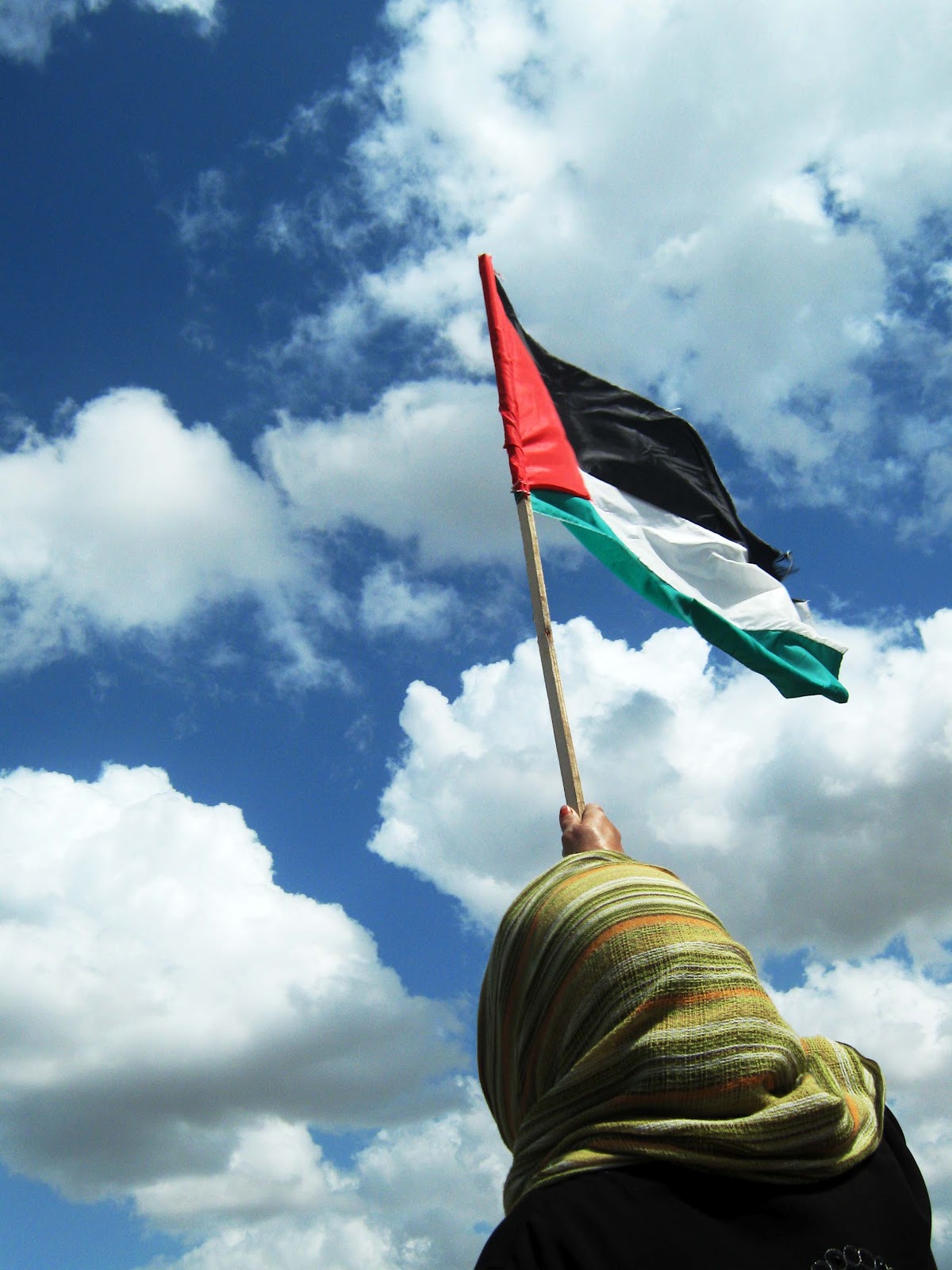
Here in OGNA we support Hamas in their plight for nonviolence. At the same time we reject Israel's inhuman approach to both sides of Palestine, as they slowly leak people through the borders to refugee camps. A fourth, more peaceful intifada is necessary and any group prepared to let the people of Palestine have their say should support the Palestinian struggle.
Friday, 15 July 2011
Te Whiti o Rongomai III (1830 – 1907)
Māori culture and war have often been closely entwined. After the development of horticulture and farming a “Warrior Culture” developed. This went on to become a core element of their society for the majority of time they have inhabited the islands of New Zealand. Different and competing groups of Māori often killed each other as they fought over land and resources which resulted in the enslavement or death of their enemies.
In the early 1800’s the British sought out to make New Zealand part of the vast British empire, which could more accurately be described as the “Brutish Empire”. The crown murdered many Māori and put a bounty on Māori heads – five pound for a head and ten pound for that of a chief. In 1867 the situation was dire with only 40,000 Māori surviving from the population of 85,000 only half a century prior. Māori culture was set to be crushed as they suffered huge blows fighting the better equipped Europeans, who’s population on the land was now close to half a million, and many died from new diseases brought to New Zealand from Europe.
In 1869 as a response to this a visionary Māori leader known as Te Whiti announced the year of “Trampling Underfoot”. Unsurprisingly the British took this as a sign of victory but they had no understanding of what Te Whiti was saying. The year of “Trampling Underfoot” was an announcement of resistance it was the year in which the people in power were to be humbled. He planned to get a separate treaty between Māori and Pakeha (whites), a treaty between equals. He is quoted as saying
"The Pakeha have some useful technology but not the kindness of heart to see that Māori also possessed much great technology which if adopted would lead to stability, peace and a great new society."
He was going to achieve this without using violence. As many Pakeha were welcome to come to New Zealand but Māori would remain the proprietors of the land.
For ten years Māori from all over the country, and a few Pakeha, travelled to Te Whiti’s settlement/sanctuary at Parihaka, the only condition for their entry was that they destroyed all of their weapons. Te Whiti, a chief in a society that had war in its very foundations saw that violence never leads to peace. He is quoted as saying
"No good thing has ever been wrought by violence ... there is no reason why violence should continue to have power over us... if any man molests me I will talk with my weapon- the tongue".
Many of the Māori who came to Parihaka carried ploughs with them. All the food consumed in Parihaka was grown there so that British goods could be boycotted.
Ten years after Te Whiti’s announcement, on the 26th of May 1879, Te Whiti came up with a plan of how to use the many ploughs that had been gathered at Parihaka in a great act of non-violent civil disobedience. All over the district, where Pakeha occupied Māori land that had not been disputed since its rightful owners were killed or driven-out, Māori started to plough the land. They received abuse and many death-threats but always remained calm and polite and continued to plough all day and every day. Te Whiti said
"Go put your hands to the plough. Look not back. If any come with guns or with swords, be not afraid. If they smite you, smite not in return. If they rend you, be not discouraged. Another will take up the good work."
This is exactly what happened.
Settlers and the government alike did not know how to combat Te Whiti’s non-violence. Some fled, some built fortresses and trenches, and some called for a “War of Extermination” – the headline chosen by the local newspaper. Unsurprisingly the government started to arrest the ploughmen and Te Whiti sent out five more each day. Every day they would get arrested without resistance and were shipped to Dunedin where they were held without trial. As the government could see that the people of Parihaha were undeterred they sent in the army who prepared for war... however when they arrived they did not know quite how to react to Māori warriors, who had fiercely fought Pakeha columns and won, giving them gifts.
By 1880 the government had spent over one million pounds and the prisons were full. The media reported on the event and it turned into a national scandal. All the prisoners were released. At this point hundreds of Māori were working the reclaimed fields. In response the army finally decided to attack. They were met by the entire population of Parihaka singing and praying. Te Whiti was finally arrested. Without his leadership the movement at Parihaka continued with Māori refusing to pay taxes and launching more ploughing campaigns.
Te Whiti died in 1907 and was buried under a cloud of white feathers. Although Māori did not regain their land and are less than 20% of New Zealand’s population, the struggle for Tino Rangatirotanga continues to this day. The people at Parihaka whom Te Whiti inspired are credited with stopping a war of genocide that would not have stopped until all Māori had died. He had a huge influence on the thoughts and actions of Mahatma Gandhi who read about him while in South Africa.
Te Whiti is a person to look up to and we must follow in his footsteps until all of the oppressed, all over the world are liberated. 

J.Llewellyn
Wednesday, 13 July 2011
Woman and Non-Violent Action in Africa: Two stories of success!
Liberia, 2003: Ordinary women end extraordinary violence.
 |
| Women Protest In Liberia |
The West-African nation of Liberia has a history of fighting for people rights and freedoms. It was founded by freed American slaves and the country’s coat of arms declares, “The love of liberty brought me here.”
Despite this fantastic start for the nation recent decades have been far less hopeful with corrupt government and drug-fueled militias run by warlords raping and killing where ever they pleased without repercussions. This comes after years of imperialist struggle to grab diamonds and other raw materials which has left Liberia 176th out 179 countries on the United Nation Human Development Index. Hundreds of thousands fled. Others were trapped by the unending violence, unable to flee. As one Liberian woman later remembered, “My children had been hungry and afraid for their entire lives.”
In the first few months of 2003, a group of women decided to try to end the conflict once and for all. Dressed all in white, hundreds of them sat by the roadside, on the route taken daily by President Charles Taylor, rebel leader-turned-president. The president’s motorcade swept past, slowing down only briefly. But the women returned, day after day. In pouring rain and blazing sunshine alike, they danced and prayed. The protests gained momentum; Religious leaders spoke out in support of the women’s demands. Radio stations began reporting sympathetically on the roadside protests. A protest leader, declared in front of the cameras, “We are tired of our children being raped. We are taking this stand because we believe tomorrow our children will ask us: ‘Mama, what was your role during the crisis?’”
Pressed on all sides, Taylor agreed to talk. He met with the women’s leaders in the presidential palace. Peace talks began but it soon became clear that the talks were going nowhere. Even as the warlords basked in the comfort of their luxury hotel, they worked the phones, directing a renewed orgy of violence at home in the Liberian capital, Monrovia. The women decided that enough was enough. Determined to focus on the human cost of the war, they barricaded delegates into the room where the talks were taking place. One of the negotiators, Nigerian General Abdulsalami Abubakar, remembered later: “They said that nobody will come out till that peace agreement was signed.” One warlord tried unsuccessfully to kick his way out of the room. Others tried (and failed) to escape through the windows.
The men with guns agreed to talk seriously at last. A peace deal was struck and Charles Taylor went into exile. Ellen Johnson-Sirleaf became Liberia’s first peacefully elected president, Africa’s first woman leader. It was ordinary Liberians who reclaimed the country and demanded peace. Even though this movement was never aimed at creating a socialist society, it is a great example of what can be achieved using non-violent action. Non-Violent organizations are needed to work as leaders in these movements, link all struggles around the to build a mass movement which will lead to equality and democracy.
Kenya, 2009: No sex without peace: Women unite in a nationwide bedroom strike.
 |
| The Prime Minister's wife even participated in the sex strike. |
In Kenya in 2009, many feared a renewal of the post-election violence that had brought the country to the brink of catastrophe a year earlier. The relationship between the two main political rivals, Prime Minister Raile Odinga and President Mwai Kibaki, remained dangerously tense. Women’s groups, fearing another descent into violence, urged men to settle their differences and, as they put it, “begin to serve the nation they represent.” To emphasize the point, they announced a sex strike. They were perhaps inspired by a similar action taken in Sudan in 2002, when thousands of women in the South took up the practice of “sexual abandoning” to compel men to end the twenty-year civil war in which an estimated two million people had died.
As with the example of Liberia this movement was never intended to create socialism. It does however serve as a great example to show how unity and creative strike action are effective ways to change society in the interests of the vast majority.
J.Llewellyn
Thanks to Steve Crawshaw and John Jackson and their book , Small Acts of Resistance: How Courage, Tenacity, and Ingenuity Can Change the World © 2010 by Steve Crawshaw and John Jackson, Union Square Press, a division of Sterling Publishing Co,. Inc.
Sunday, 3 July 2011
A Continuing Struggle Regarding the Status of Women: Pro-democracy Movements in the Middle East
The strong presence of women in recent pro-democracy protests Iran, Bahrain, Yemen, Oman, Tunisia, Libya and Egypt created an atmosphere of excitement regarding the 100th Anniversary of International Women’s Day (IWD) on March 8 this year.
Iran in particular has seen decades of very public women’s liberation movements, exemplified by the ongoing One Million Signatures Campaign that aims to gain one million signatures to petition for a change in discriminatory laws against women.
 |
| A mural painted by the organisers of the One Million Signatures campagin |
March 8 signified an opportunity to celebrate recent victories, the newfound unity between Middle Eastern men and women in the fight against oppression and inequality, and to make a public statement about the currently changeable social and political atmosphere.
In the week leading up to IWD, however, there was a strong reminder that the recent political changes are only one step towards the desired objective of a democratic society unblemished by gender-, race-, or sexuality-based discrimination; the newfound position of Iran on the United Nations Commission on the Status of Women (CSW). The CSW is a body "dedicated exclusively to gender equality and advancement of women," noble a purpose inconsistent with Iran’s horrendous record of upholding the most basic human rights.
Iran’s election for the 2011-2015 position on the Commission was passed in April 2010, just a week after senior cleric and acting Friday prayer leader of Tehran, Hojatoleslam Kazem Sedighi, stated that the wearing of revealing clothes by Iranian women is to blame for the nation’s increasing number of earthquakes.
“Many women who do not dress modestly ... lead young men astray, corrupt their chastity and spread adultery in society, which (consequently) increases earthquakes,"
Sedighi was quoted as saying by Iranian media; A laughable but serious blow to women across the world who choose the right of self-expression and determination in the face of oppressive religious dogma.
Understandably, the election of Iran to the CSW was passed despite stark opposition by Iranian activists for women’s rights. A letter signed by 214 activists and endorsed by over a dozen human rights bodies was written to the UN detailing Iranian laws that demonstrate the nation’s lack of commitment to gender equality:
"Women lack the ability to choose their husbands, have no independent right to education after marriage, no right to divorce, no right to child custody, have no protection from violent treatment in public spaces, are restricted by quotas for women's admission at universities, and are arrested, beaten, and imprisoned for peacefully seeking change of such laws.”
Iran, a country that legalizes the stoning of adulterers, the rape of virgins before execution, sigheh (temporary marriage), and forced wearing of the hijab is now to have a leading voice on global issue affecting women. Notably, Iran does so despite having signed the UN Convention on the Elimination of All Forms of Discrimination Against Women. Such incongruence between actions and words of Iran highlights the inability of organisations such as the UN to effect real change whilst working within the constraints of the corrupt bureaucratic system of our current society. This is just one example of the failure of the UN to act in the interests of the majority of the world’s population.
Regarding the election of Iran to the CSW, UN defence of its decision rests on geographic principles; the principle of equitable regional representation, UN officials say, must be taken into account when offering membership.
Acknowledging this, Iranian activists argued one representative from Asian nations, as opposed to the normal two, would be preferable to elevating Iran to the commission in light of the “the highly negative ramifications of Iran’s membership in this international body." But it seems such recommendations have fallen on deaf ears.
Sadly, signs of ensuing negative ramifications can already be seen. Only months after its election to the CSW in 2010, 18-year-old Iranian Navid Mohebbi was arrested with charges of threatening national security, promoting anti-Iran propaganda, and insulting current and former leaders of Iran – a guise for the real ‘crime’ of keeping a blog supporting women’s rights.
“For the women of my own country who are being brutally suppressed in the most vicious manner, I wish a society without violence, oppression and without gender-specific violence."
Following his arrest, Navid was subject to interrogation, held in solitary confinement for extended periods of time, denied legal counsel or contact with family; essentially, denied a fair trial.
Luckily, a petition initiated by A Safe World for Women containing the signatures of 600 Change.org members was successful in suspending Navid’s three year sentence, Navid being released on Christmas Day 2010; A tribute to the effectiveness of non-violent protest in the face of grave oppression.
It is an anomaly that a body dedicated to advocating and pursuing the advancement of women in society could appoint to its governing board a nation whose government is actively opposed to achieving such a goal.
Yet such incongruence is to be expected under Capitalism. Any organisation “committed to maintaining international peace and security, developing friendly relations among nations and promoting social progress, better living standards and human rights”, as the UN states they are, is doomed to fail in a society where the means of production are owned by a special few, production is based on profit not need, and workers are increasingly exploited as a means to obtain ever-increasing profit. True change can never come about in a system where a small majority own most of the world’s wealth and control the lives of the majority.
A fundamental change to the economic state of society is needed to ever achieve equal living standards, full possession of human rights, equal opportunity and a lack of gender-, race- or sexuality-based discrimination. A fundamental change that will never come from the UN is needed to achieve Navid’s dream of an egalitarian, oppression-free society, not just in Iran but across the world. An economic system in which the means of production are commonly owned and controlled co-operatively based on the needs of society as a whole, where the distribution of wealth serves the interests of society as a whole, is needed for this to be achieved. That is, socialism is needed.
The struggle for women continues, most notably at this point in history in the Middle East. Actions greater than what diplomatic organisations such as the UN can provide are needed for true progress. The key to ending all oppression is through the self-emancipation of the working class. We need to create active non-violent organisations to lead the struggle.
R.L.Bradley
Wednesday, 29 June 2011
The Arab Spring and the triumf of Non-Violent Action
The Arab spring of 2011 has changed the Middle East and the world. Ordinary people have lost their fear and shattered the perception that their rulers are invincible and that it is impossible to overthrow dictators without arms. Whatever happens next, the changes across the region in the first few months of 2011 have proven themselves historic as they show that revolution is possible.
It all started in Tunisia with mass protests in December last year. These were triggered by the self-immolation of a 26-year-old vegetable seller, Mohammed Bouazizi, after he was abused by police and had his only form of income, a box of vegetables and a pair of scales, confiscated. The protests continued for four weeks and concluded in a way nobody predicted - Zine el Abidine Ben Ali, Tunisia’s president for the past 23 years, fled the country.
Even though this amazing feat had occurred nobody predicted that it would spread as far as it did with protests and strikes kicking up all over the Middle East. In Egypt the 30-year-old dictatorship of Hosni Mubarek was seen by most as being far too ruthless for protests to succeed in any way- certainly in toppling the dictator. Millions of people took to the streets after posters on university campuses called for a non-violent protest and Tahrir square was occupied. The initial demands to topple Mubarek quickly turned into demands for womans rights; fair pay; the right to food ect. After 18 days of protests, Hosni Mubarek was gone.
The fight for liberation in the Middle-East is continuing today. The toppling of Ben Ali and Mubarak is only the start as protests spread and demands for equality and good living conditions continue. Organisation through socialist groups and trade unions is vital in order for everyone to work coherently, nationally and internationally, so they can force the remaining working class out of power and include everyone in society, making links between the causes of all the different struggles across the world. Struggles that are all fighting against a common oppressor - Capitalism and the class system.
Victories like in Egypt and Tunisia that used non-violent action are not new. Throughout history both recent and distant, ordinary people have found innovative and inspiring ways to challenge violent regimes and confront abuses of power: bringing down dictators, changing unjust laws, or simply giving individuals a renewed sense of their own humanity in the face of those who deny it. It goes to show how non-violent tactics can achieve huge advancements even when facing a repressive and brutish state. Violent protests in the Middle East have failed. States use brutal force in such a way and with such power that even if guns are available to the masses, it is impossible to confront. This is true now more than ever with the advanced technology available to states such as Israel and the USA.
The main use of violence by the oppressed in the Arab revolutions so far is in Libya where guns were picked up by rebels to fight. They were initially bombed out by the Libyan air-force, of which their guns had no chance of defeating. This then paved the way for NATO forces to walk in on apparently “humanitarian” grounds. The result of this has been huge numbers of civilian deaths, NATO securing key ports that export oil to Europe, and even huge casualties for the rebels. This was a much less constructive method as compared to Egypt, where due to the tactics used by the protesters, through strikes and the occupation of Tahrir square, the protesters had much more control over the country, had must bigger numbers due largely to the lack of violent ideas. Obama, who’s government was an active supporter of Mubarak, was forced to say that it was good that the Egyptians were fighting for democratic rights and was unable to intervene. This differs greatly from the response he and NATO gave in Libya, where people were also fighting for true democracy as in Egypt. The USA’s interests were secured and the Libyan peoples ignored.
Non-violent tactics in Egypt also lead to key members of the army and police joining the protests. It was clear to see that the people in the army, who mostly entered it as members of the working class as a means to survive, could connect to the protesters cause as it was also theirs and their families cause. It is common sense that if these members of the army were being shot at they would be unlikely to react in the same way. This was shown as mention previously with the military in Libya. Does it not seem like common sense that is impossible to win a revolution without the army on side and this will be hard to achieve when you are shooting at them?
The Arab revolutions have shown that when the masses take to the streets and take control of means of production they can revolutionise society, even in the face of hugely repressive forces. They have also helped demonstrate the effectiveness of non-violent action and how it is ultimately more successful than violence. The Arab revolutions came as the result of decades if not centuries of oppression from the ruling classes that ensure members of the poor, working class do not have access to the basic necessities of life. They arose from the spark created by Mohammed Bouazizi but lacked political organizations to unite all of the struggles into one that could unite the masses against their common oppressor with the aim of creating true democracy. This could still happen at any moment and the struggles in the Middle East continue. Removing the dictators was only the first step. The real change that the Arab people are struggling for is yet to come…The fantastic thing is that it has started to.
J.Llewellyn
It all started in Tunisia with mass protests in December last year. These were triggered by the self-immolation of a 26-year-old vegetable seller, Mohammed Bouazizi, after he was abused by police and had his only form of income, a box of vegetables and a pair of scales, confiscated. The protests continued for four weeks and concluded in a way nobody predicted - Zine el Abidine Ben Ali, Tunisia’s president for the past 23 years, fled the country.
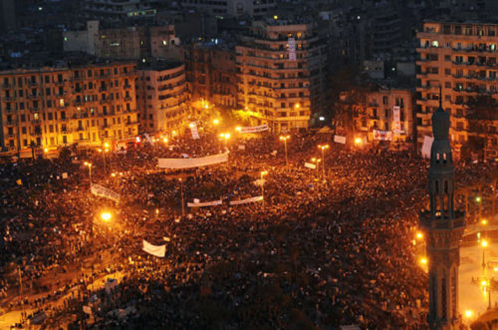 |
| Tahrir Square occupied |
The fight for liberation in the Middle-East is continuing today. The toppling of Ben Ali and Mubarak is only the start as protests spread and demands for equality and good living conditions continue. Organisation through socialist groups and trade unions is vital in order for everyone to work coherently, nationally and internationally, so they can force the remaining working class out of power and include everyone in society, making links between the causes of all the different struggles across the world. Struggles that are all fighting against a common oppressor - Capitalism and the class system.
Victories like in Egypt and Tunisia that used non-violent action are not new. Throughout history both recent and distant, ordinary people have found innovative and inspiring ways to challenge violent regimes and confront abuses of power: bringing down dictators, changing unjust laws, or simply giving individuals a renewed sense of their own humanity in the face of those who deny it. It goes to show how non-violent tactics can achieve huge advancements even when facing a repressive and brutish state. Violent protests in the Middle East have failed. States use brutal force in such a way and with such power that even if guns are available to the masses, it is impossible to confront. This is true now more than ever with the advanced technology available to states such as Israel and the USA.
 |
| Lone protestor stands up to police in Egypt |
Non-violent tactics in Egypt also lead to key members of the army and police joining the protests. It was clear to see that the people in the army, who mostly entered it as members of the working class as a means to survive, could connect to the protesters cause as it was also theirs and their families cause. It is common sense that if these members of the army were being shot at they would be unlikely to react in the same way. This was shown as mention previously with the military in Libya. Does it not seem like common sense that is impossible to win a revolution without the army on side and this will be hard to achieve when you are shooting at them?
The Arab revolutions have shown that when the masses take to the streets and take control of means of production they can revolutionise society, even in the face of hugely repressive forces. They have also helped demonstrate the effectiveness of non-violent action and how it is ultimately more successful than violence. The Arab revolutions came as the result of decades if not centuries of oppression from the ruling classes that ensure members of the poor, working class do not have access to the basic necessities of life. They arose from the spark created by Mohammed Bouazizi but lacked political organizations to unite all of the struggles into one that could unite the masses against their common oppressor with the aim of creating true democracy. This could still happen at any moment and the struggles in the Middle East continue. Removing the dictators was only the first step. The real change that the Arab people are struggling for is yet to come…The fantastic thing is that it has started to.
J.Llewellyn
Subscribe to:
Posts (Atom)